

 By
You have a bike, or you are about to buy one, and one worry keeps coming back: what if you do it wrong? you are not alone most people who are just thinking about starting cycling have the same worry.
Before their first ride as an adult, they spent evenings reading about gear and never once thought about whether the saddle was at the right height.
The good news is that how to start cycling comes down to a short list of decisions, made in a sensible order. Get a bike that fits, check it before you ride, keep your first rides short and easy, and learn the rules where you live.
This guide walks through those steps for adults riding in the US, Canada, the UK, or Australia. You do not need special clothing, a fitness test, or a fast bike. Where a rule or a number matters, the source is named so you can check it yourself.
Quick Takeaways:
- Start with a bike that fits and passes a two-minute ABC check: air, brakes, chain, quick release.
- Set the saddle with the heel method: heel on the pedal at the bottom of the stroke, leg straight. Your knee will have a slight bend once your foot is in its normal riding position.
- Ride 20 to 30 minutes at an easy pace, two or three times a week, and add time slowly. The CDC’s 150 minutes a week is a destination, not a week-one target.
- Helmets are mandatory for all ages in every Australian state and territory. Rules vary by state, province, or locality in the US and Canada.
- In the UK, a white front light and a red rear light must be lit at night. Check your own local lighting rules elsewhere.
Decide What You Want Cycling To Do For You
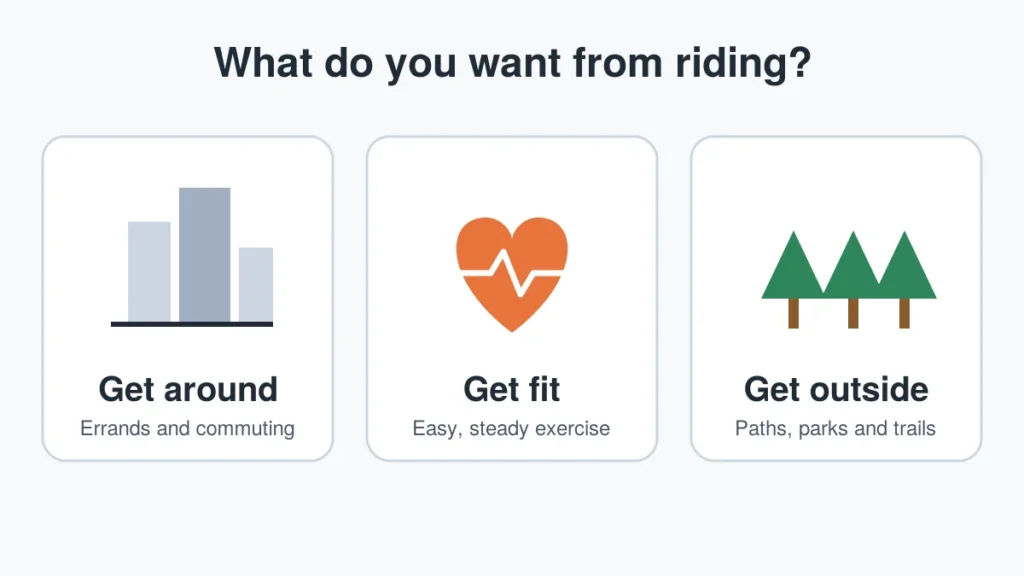
Your goal shapes almost every later choice, so name it before you shop. Most new riders want one of three things: a way to get around, a way to get fit, or a reason to be outside.
As a kid, my first goal was not ambitious: ride to the community ground with everyone else instead of walking beside them. It was specific, and that helped more than any plan would have.
If the goal is fitness, a loop near home that you can repeat matters more than which bike you own. If it is trails, find out what the surface demands before you buy anything.
Pick the goal you would still do on a grey Tuesday. That is the one that survives past the first month.
If health is part of your reason, the CDC says adults need at least 150 minutes of moderate-intensity activity a week, and that it does not have to happen all at once. Treat that figure as where you are heading. Anyone who has been inactive for a long time, or who lives with a health condition, should talk to a doctor before ramping up.
Choose A Bike That Fits And That You Will Actually Ride
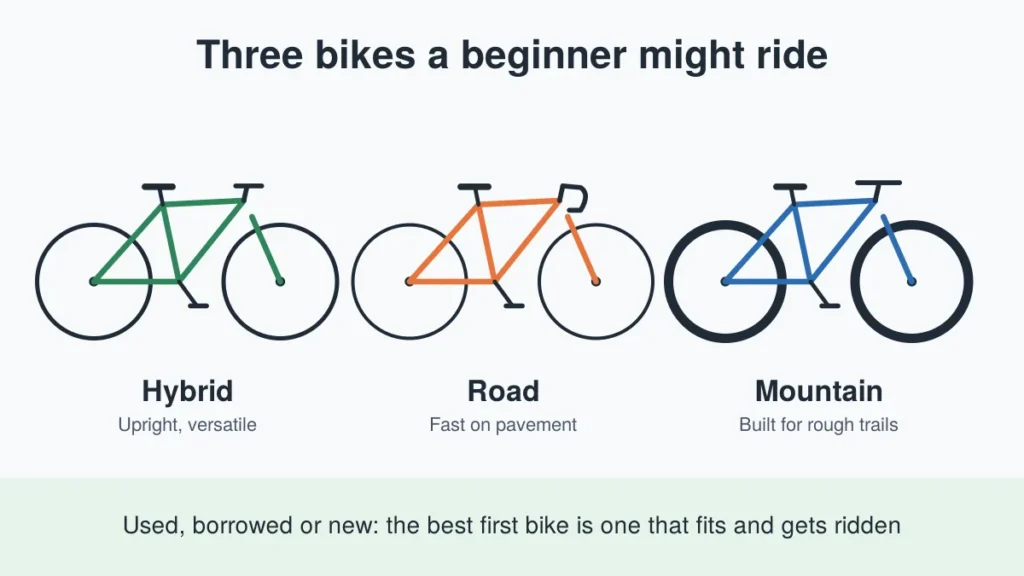
Three bike types cover most first purchases.
A hybrid has an upright position, flat handlebars, and tires that handle pavement and light paths. A road bike has drop handlebars and narrow tires, and rewards a stretched, faster position that takes time to get used to. A mountain bike has wide, knobby tires built for rough trails, which usually feels slower on pavement.
Here is a simple decision rule. If most of your riding will be on streets and paved paths, start with a hybrid. If you already know you want dirt trails, a mountain bike makes sense. Choose a road bike when you want to ride fast on pavement and are happy with a more bent-over position.
Fit matters more than type. A bike shop can size you in minutes, and a test ride shows what a spec sheet cannot: whether you can reach the handlebars and brake levers comfortably, and whether you can put a foot down when you stop. Sizing charts differ from brand to brand, so treat a size label as a starting point.
Borrowing a bike or buying used is a sensible first step. Have a shop look over a used bike before you ride it: tires, brakes, chain, and a check for cracks in the frame. If it needs work, ask for a repair quote before you buy, because the fix can cost more than the bike is worth.
my friend’s was a used hybrid a coworker was selling. The shop that checked it replaced the brake pads and the chain, neither of which he would have spotted myself.
Buy The Short Gear List First
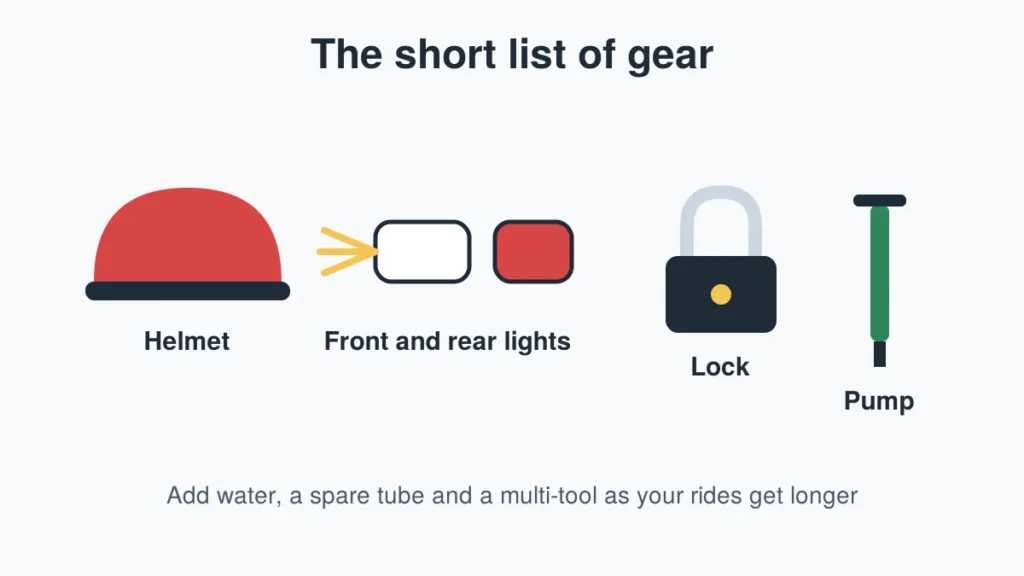
Everyday clothes are fine for relaxed riding around town. Spend on a few items first, in this order:
- Helmet. Choose one that sits snug and level on your head, with the straps snug. A helmet is designed to reduce the risk of head injury in a crash. It does not make riding risk-free.
- Lights. A white front light and a red rear light, even if you plan to be home before dark. I skipped them for my first two weeks for exactly that reason, until a ride ran late and the last mile was in dusk. Plans slip, and winter daylight ends early.
- Lock. If the bike will ever sit outside a shop or station, buy a good lock before you need one.
- Pump, spare tube, and tire levers. A flat tire (a puncture, in the UK and Australia) is a common reason for a ride to end early, and the repair takes minutes once you have practiced. Make sure the pump head fits your valve type, Presta or Schrader.
- Water bottle. Worth carrying once rides run longer than a short loop.
Padded shorts are worth considering once saddle discomfort shows up, not before. Cycling shoes and clip-in pedals can wait. Flat pedals and ordinary trainers (sneakers) work well while you learn.
Set Up The Bike Before The First Ride
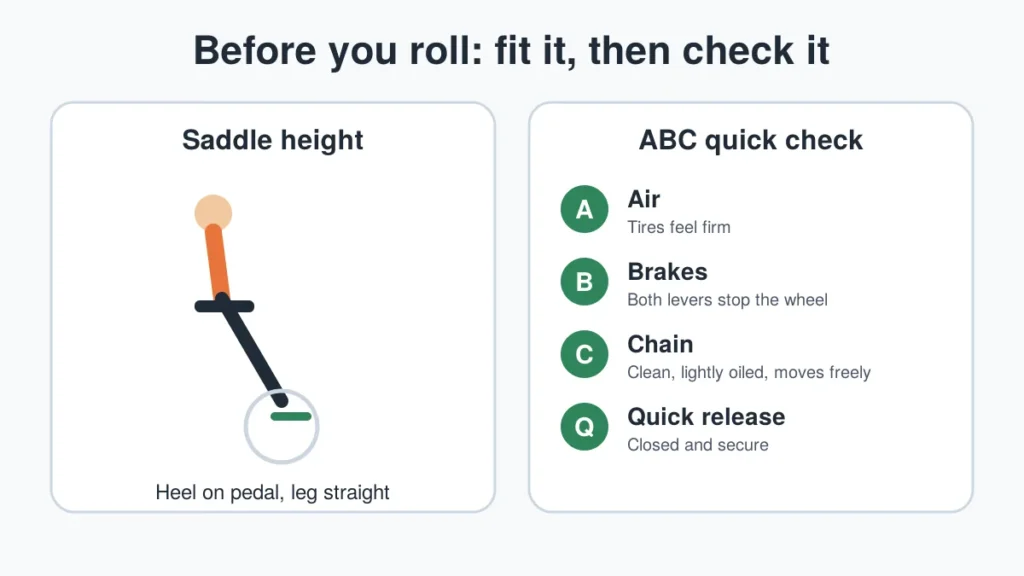
Two quick jobs: set the saddle, then run the ABC check.
Start with saddle height. Sit on the bike, put your heel on the pedal at the bottom of the stroke, and raise the saddle until your leg is straight without your hips rocking. Cycling UK’s guidance adds that once the ball of your foot is on the pedal, your leg should have a slight bend of about 25 to 30 degrees at the bottom of each stroke.
Saddles set too low are a common sight on beginner bikes. A low saddle feels safer because your feet reach the ground, so if you are nervous, start slightly low and raise it over your first few rides until the heel test passes.
From my own experience if the saddle is couple of inches low, my knees ache by the third ride; raising it to pass the heel test fixed that for me. Knee or lower-back pain is a reason to book a bike fit, not something to push through.
Then run the ABC quick check before every ride:
- A is for air. Tires should feel firm. The recommended pressure is printed on the tire sidewall.
- B is for brakes. Squeeze each lever. The wheel should stop, and the lever should not touch the handlebar.
- C is for chain. It should be clean, lightly lubricated, and move freely as you pedal.
- Quick release. If your wheels or seat clamp use quick-release levers, confirm they are closed.
Finish with a slow lap of the block to test the gears and brakes. If anything feels wrong, take the bike to a shop before you ride it properly.
How To Start Cycling: Plan Your First Rides
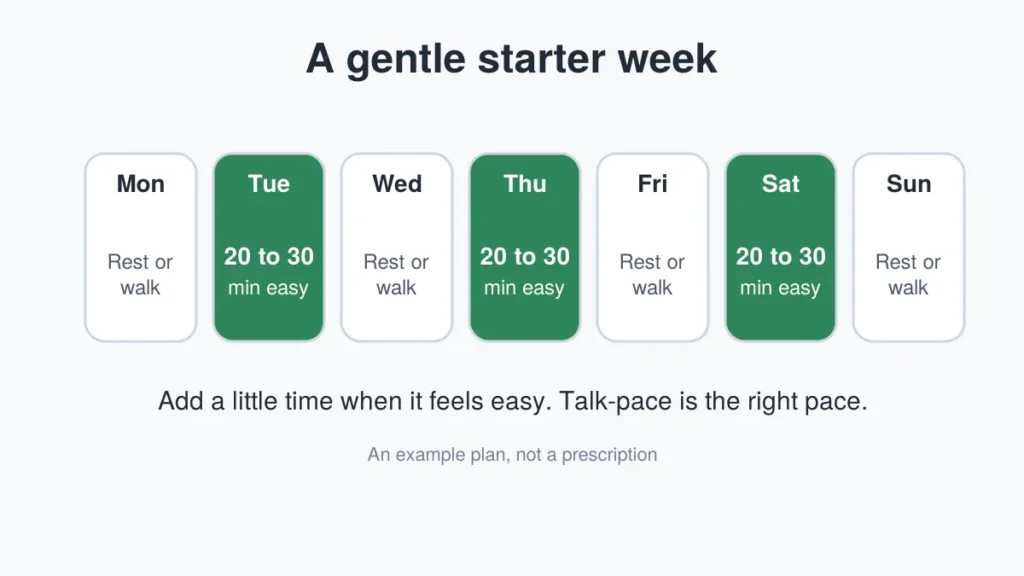
Start shorter than feels necessary. Common beginner advice is 20 to 30 minutes, two or three times a week, with rest days between. Coaches at TrainRight put the principle plainly: start with volume and add intensity later, not the other way round.
Choose a pace you could keep while talking. Out-and-back routes suit beginners because the turnaround is built in: ride 10 minutes out, turn around, and you have a 20-minute ride with no decisions about distance. For the very first outing, an empty car park (parking lot) or a quiet street lets you practice starting, stopping, and steering with no traffic to think about.
My advice for my friend’s first ride was exactly that: 10 minutes out, 10 back, around a church parking lot and then a quiet street. he expected his lungs to be the limit. It was his hands and the spot where he sat, and the next morning he learned which leg muscles he had been ignoring.
When a ride starts to feel easy, add a few minutes. Ignore speed for now. Some soreness is normal early on, but pain is not, and a bike fitter or health professional can help you work out why.
As your rides get longer, the CDC’s 150 minutes a week becomes realistic. Reaching it gradually, over weeks to months, is a better plan than reaching it in week one.
Learn The Handful Of Skills That Matter
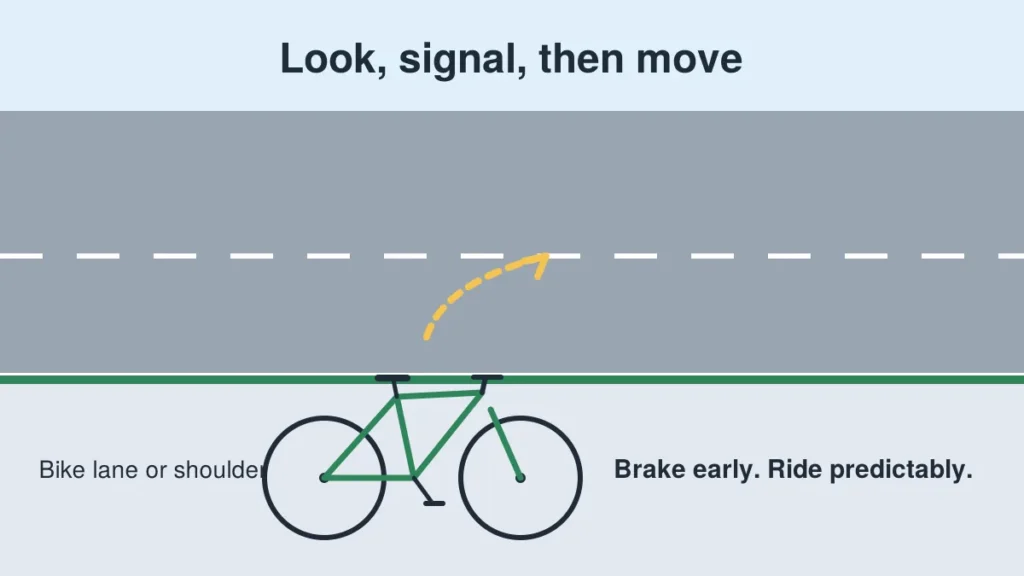
Beginners tend to worry about speed and fitness. The skills that actually keep a ride smooth are smaller and easy to practice.
Shift before you need to. Change to an easier gear before a hill or a stop, while you are still pedaling lightly. A gear that is too hard is a classic beginner mistake, and it wears out your legs quickly.
Brake early, with both levers. Squeeze smoothly and slow down before a corner, not in the middle of it.
Look before you move. Glance behind, give a clear hand signal, then change position. Learn the signals used where you ride.
Ride predictably. Hold a steady line and avoid weaving in and out of parked cars. Drivers cope with cyclists they can anticipate.
Practice a flat repair once at home. Practice in the kitchen with a spare tube and the pump you actually carry, and the roadside version becomes routine.
Many regions offer adult cycling skills courses through local councils or cycling advocacy groups. If traffic worries you, a short course is a fast way to build confidence.
Know The Rules Where You Ride
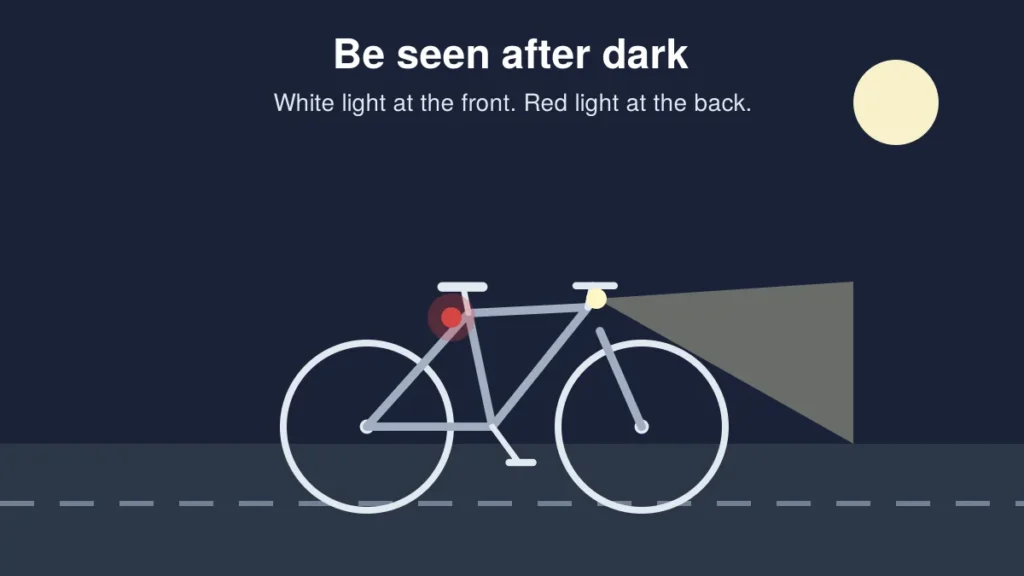
Helmet and lighting laws differ between countries, and often between states and provinces. This is what the sources checked for this article say:
| Country | Helmet rule |
|---|---|
| Australia | Mandatory in all states and territories, for all ages |
| United States | No federal law. Many states and localities have laws, often for riders under 18, and some areas cover all ages |
| Canada | Set by provinces and territories, so it depends where you live |
| United Kingdom | No legal requirement to wear a cycle helmet |
Even where helmets are optional, many clubs and organized events require them.
For lights, the UK is clear.
Rule 60 of the Highway Code says that at night your cycle must have a white front light and a red rear light lit, plus a red rear reflector, and amber pedal reflectors if the bike was made after 1 October 1985.
Flashing lights are permitted, but a steady front lamp is recommended where there is no street lighting. For the US, Canada, and Australia, check your state, province, or territory. Whatever the law says, lights make you easier to see.
Rules change and local ones vary, so confirm with your local authority before you rely on any of this.
Make The Habit Stick
The first month often decides whether cycling becomes a habit or a bike in the garage. Two things help most: a ride you actually enjoy, and a reason to repeat it.
Tie rides to something you already do. What worked for me was one 20-minute loop after work on Tuesday and Thursday, the same route every time. A repeatable route removes planning, and once I stopped asking myself where to ride, the ride happened far more often.
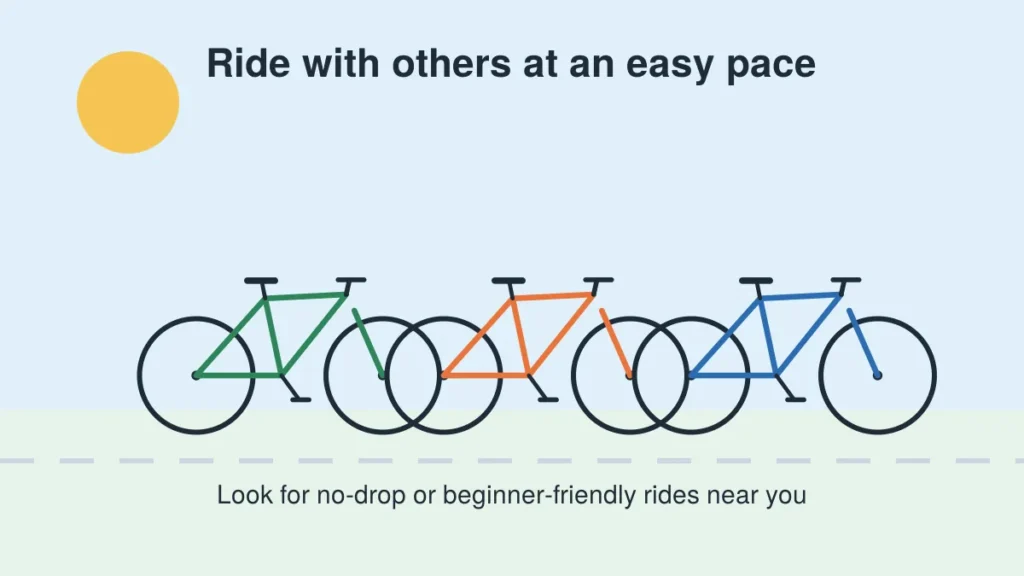
Riding with others helps too. Group rides build skills like speed control, bike handling, and braking, and many clubs run no-drop rides, where the group waits so nobody gets left behind. Ask a local bike shop or cycling group which rides welcome beginners.
Measure progress in minutes ridden and in how the ride feels, not in speed. A ride that felt hard in week one and feels easy in week four is real progress.
Frequently Asked Questions
What do I need to start cycling?
A bike that fits, a helmet, lights for any riding near dusk, a lock if you will park outside, and a pump with a spare tube. Everyday clothes are fine at first. Add padded shorts or cycling shoes later, only if a specific problem shows up.
How long should a beginner ride?
Common beginner advice is 20 to 30 minutes, two or three times a week, at an easy pace. Add a few minutes when rides feel comfortable. The CDC’s 150 minutes of moderate activity a week is a longer-term target, reached gradually rather than immediately.
Do I need to buy a new bike?
No. A borrowed or used bike works well if it fits and a shop has checked the brakes, tires, chain, and frame. A bike you ride regularly beats an expensive one that stays in the garage, so fit and condition matter more than newness.
Is it normal to feel sore when I start?
Some soreness is normal while your body adjusts, especially in the legs and where you sit. Pain is different. If you feel pain in your knees, back, or hands, check your saddle height and fit, and see a bike fitter or health professional.
Do I have to wear a helmet?
It depends on where you live. Australia requires helmets for all ages in every state and territory. In the US and Canada, laws vary by state, province, or locality. The UK has no legal requirement. A helmet is designed to reduce head injury risk, so many riders wear one regardless.
Where should I ride first?
Somewhere with little traffic: an empty car park (parking lot), a quiet street, or a bike path. Practice starting, stopping, steering, and shifting there first. Out-and-back routes near home work well because you can turn around whenever the ride feels like enough.
Your First Ride: A Simple Plan For This Weekend
Pick a day and a time, and keep the plan small. Do the ABC check, put on your helmet, and ride 10 minutes out on the quietest route you know. Turn around and ride home.
Afterward, note one thing that felt off, such as the saddle height, your hands, or a gear that was hard to find, and change just that one thing before the next ride. Small adjustments, made one at a time, are how a bike goes from borrowed-feeling to yours. After my first ride, the one thing to change was the saddle, and it was the easiest fix of the lot.
Written by Raaz. Raaz is passionate about bikes and the world of cycling, exploring everything from mountain biking and road cycling to bike maintenance, gear, and outdoor adventures. Raaz aims to make cycling easier to understand and help readers make confident decisions.