

 By
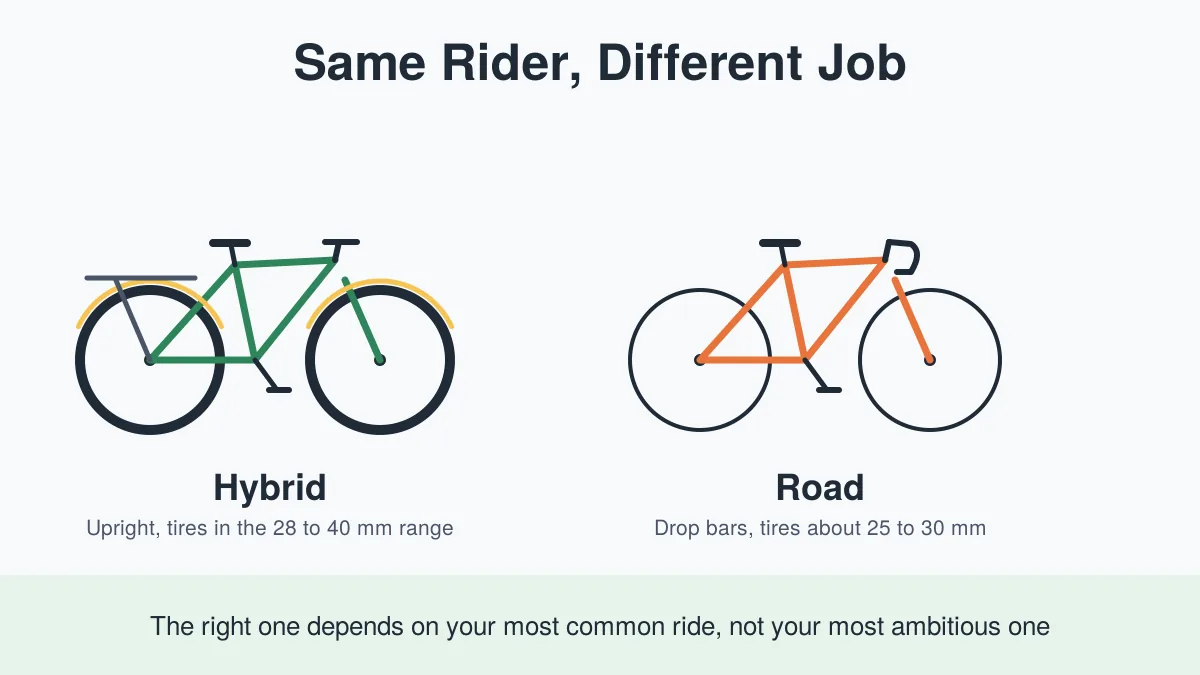
You’re standing in a bike shop, looking at two bikes that seem to want the same job. One has flat bars and sturdy tires. The other has drop bars and a lean, hungry look.
I’ve ridden both for about two decades, and the hybrid vs road bike question reaches me more than almost any other. The answer isn’t “road is fast, hybrid is comfy.” Each bike rewards a different kind of ride, and most people pick for the ride they imagine instead of the one they actually do.
So I built a simple speed model, pulled the tire and fit facts together, and wrote down the rules I use myself. By the end, you’ll know which bike fits how you ride.
Quick Takeaways:
- Riding position, not tire width, creates most of the speed gap. In my model, a rider in the drops goes about 1 to 1.4 mph (1.6 to 2.3 km/h) faster at the same effort on flat ground.
- Below about 12 mph (19 km/h), the road position saves only around 8 watts in that model, so a hybrid costs you very little at city speeds.
- Choose a hybrid for errands, rain, bags, rough paths, and stop and go riding. Choose a road bike for steady paved miles, group rides, and distance.
- Many hybrids come with rack and fender mounts. Some road bikes do too, so check the exact model.
- If you can’t decide, test an endurance road bike or a gravel bike, which sits between the two.
The Short Answer: Match the Bike to Your Most Common Ride
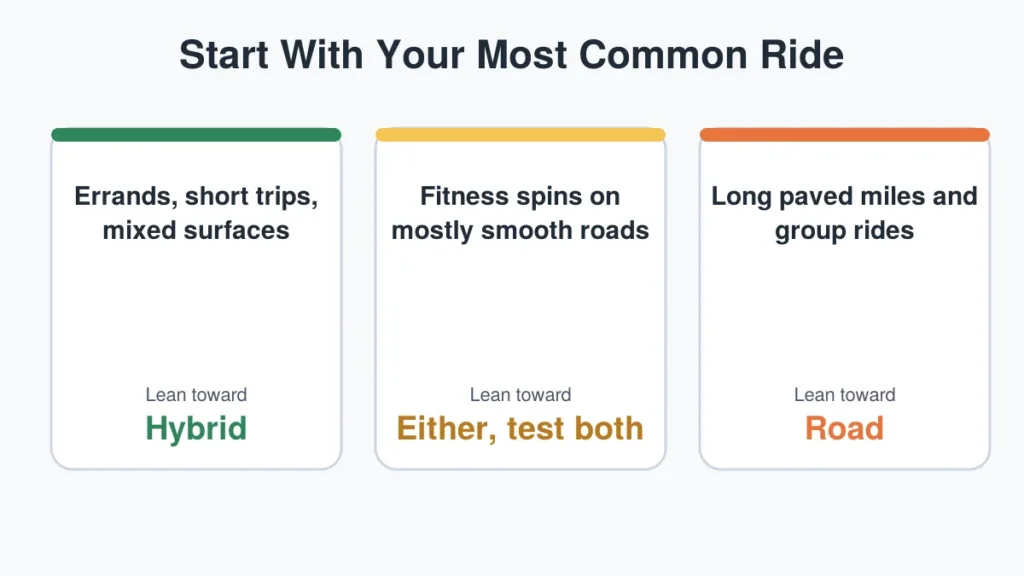
Start with the ride you do most often, not the one you hope to do someday. If it’s a short trip with a bag, a mix of surfaces, or a stop every few blocks, a hybrid fits. If it’s a steady loop on smooth pavement or a group ride, a road bike fits.
The table turns that into a quick match.
| Your Usual Ride | Lean Toward | Why |
|---|---|---|
| Commuting with a bag in all weather | Hybrid | Upright position, fender and rack mounts |
| Patchy bike lanes and park paths | Hybrid | Wider tires, steady handling |
| Smooth fitness loops | Either | Position matters more than the label |
| Group rides and long paved days | Road | Lower position, several hand positions |
Notice the fitness row says either. That’s deliberate, and the numbers further down show why.
What Actually Separates a Hybrid From a Road Bike
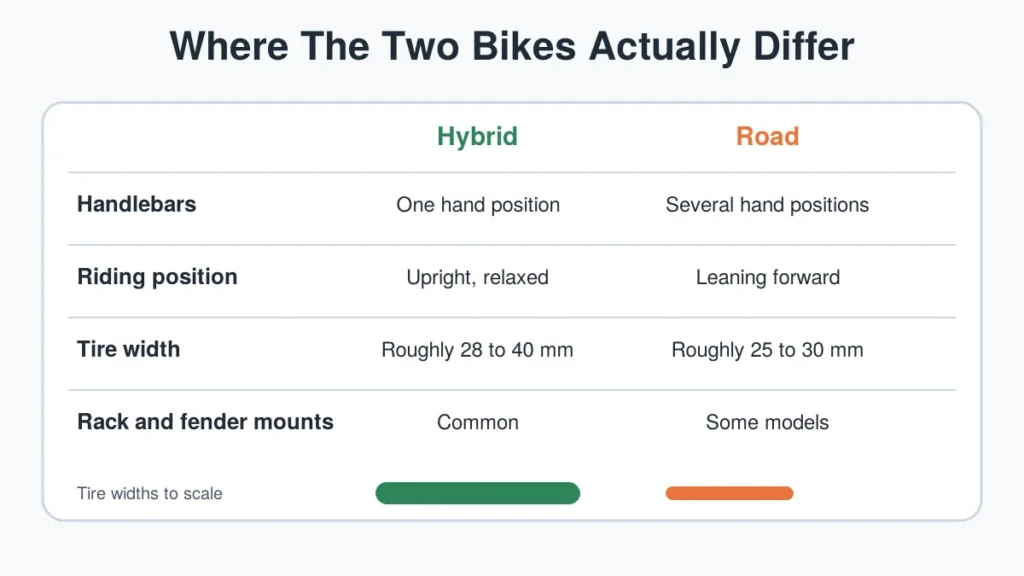
Four things set these bikes apart: how you sit, how wide the tires are, what you can bolt on, and how many places your hands can go. Everything else is detail.
Handlebars and Riding Position
A hybrid gives you flat bars and an upright seat. You see more, steer easily, and feel steady in traffic and tight spaces, which is how Canyon describes it. A road bike’s geometry is built around drop bars and a lower, longer stance.
That stance isn’t a style choice. It’s the biggest factor in how fast you go, and I’ll show you the numbers shortly.
Tires and Clearance
Road tires typically run 25 to 28 mm wide. Hybrids commonly sit around 28 to 32 mm, and many frames take 38 to 40 mm. Sources vary a little, so check the specific bike you’re considering.
Here’s a detail that surprises people. WorldTour racers have moved to 28 or even 30 mm on the road, so the idea of a skinny road tire is fading. Hybrid tires also tend to be thicker and heavier, which Cycling News links to better puncture protection.
Mounts and Carrying Capacity
Hybrids generally come with mounts for fenders (mudguards) and a rear rack. Some road bikes have them too, so look for small threaded holes near the axles before you assume.
I’m a fenders person. On a wet morning I’ll take a mudguard over a lighter bike every time.
How Much Faster Is a Road Bike, Really?
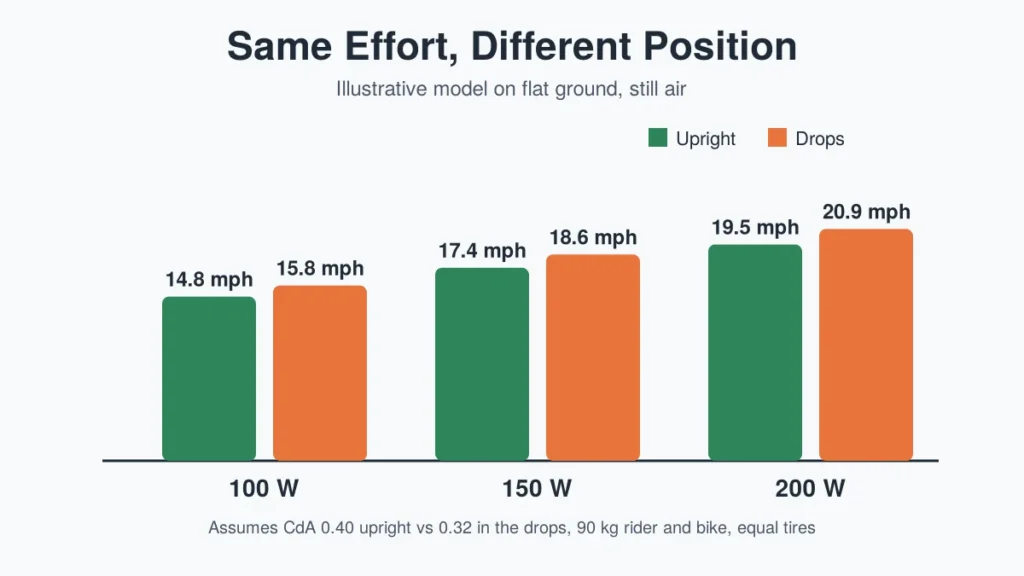
Everybody says road bikes are faster. I wanted a number, so I ran a simple physics model instead of repeating the claim.
Above walking pace, most of what slows you down is air. Drag climbs with the square of your speed, and a coach who works with WorldTour riders puts roughly 80 percent of it on the rider’s body, not the bike.
A computer simulation from SimScale found the drops position has about 20 percent less frontal area than sitting upright.
What the Numbers Show at Each Speed
I used published drag figures for the two positions: a CdA (drag area) of about 0.40 for an upright rider and 0.32 in the drops. Then I calculated the power each position needs at a given speed, on flat ground with no wind.
| Speed | Upright | In the Drops | Power Saved |
|---|---|---|---|
| 10 mph (16 km/h) | 42 W | 37 W | 5 W |
| 12 mph (19 km/h) | 62 W | 54 W | 8 W |
| 15 mph (24 km/h) | 103 W | 89 W | 14 W |
| 18 mph (29 km/h) | 163 W | 138 W | 25 W |
| 20 mph (32 km/h) | 215 W | 180 W | 35 W |
Flip it around and hold effort steady. At 150 W, the upright rider cruises at about 17.4 mph (28.0 km/h), and the rider in the drops at about 18.6 mph (30.0 km/h). That’s roughly 7 percent faster.
So the gap is real, and it’s smaller than most people expect. It also grows quickly with speed: 5 watts at 10 mph, 35 watts at 20.
Assumptions Behind the Numbers
- Rider plus bike weigh 90 kg (about 198 lb).
- Rolling resistance is the same for both, so position is the only variable.
- Sea level air, flat road, still air.
- CdA values come from published ranges: 0.35 to 0.40 upright, 0.30 to 0.35 in the drops.
I ran this myself, so treat it as an illustration, not a lab test. Real hybrids can weigh more, tires differ, and wind changes everything.
Where the Gap Nearly Disappears
City riding rarely holds above 12 mph for long. At that speed my model shows 8 watts of difference, which you’d feel less than the view over a car roof.
A friend learned the other side of this the hard way. He bought a hybrid for fitness, joined a flat Saturday group ride, and spent the morning at the back in a headwind. Same legs, same effort, but the group was riding at speeds where position costs the most.
Why Tire Width Isn’t the Villain
Plenty of guides blame the wider tires on a hybrid. The data is messier than that.
In one lab test of the same tire model in 23, 25, and 28 mm, the 28 mm rolled easiest at equal pressure. BikeRadar’s roller tests showed the ranking can flip once you set pressure for each width, which is how people really ride.
A tire maker’s own test (Rene Herse, so read it with that in mind) found smooth roads punished nobody for going wider, up to 44 mm.
The tire itself matters more than its width. If your hybrid feels sluggish, look at the tread first, because a smoother tire is a far cheaper change than a new bike.
Which Bike Fits Which Rider?
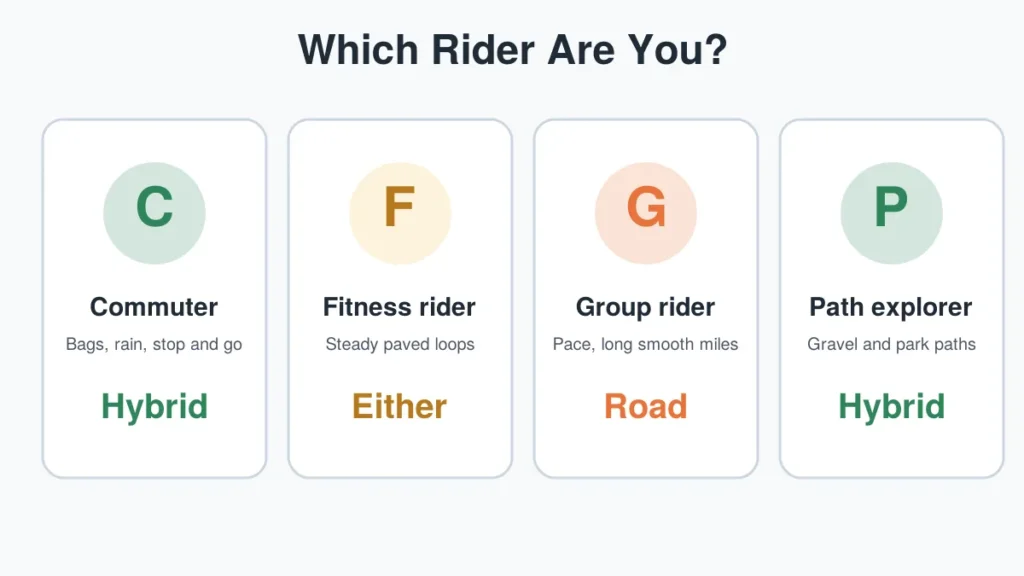
Numbers help, but you ride in a real life with bags, hills, and weather. Here are four riders, all hypothetical, and where I’d point each one.
The Commuter With a Bag and a Schedule
Picture a 6 mile (10 km) commute with a laptop bag and rain in the forecast. You’ll mostly sit under 15 mph, where my model shows 14 watts or less of difference.
A hybrid with fenders and a rack keeps you dry, upright, and in control at lights. That’s the bike I’d choose.
The Weekend Fitness Rider
Picture a 45 minute loop on smooth pavement, three mornings a week. Either bike works here, and the better one is whichever gets you out the door.
A hybrid is forgiving while your handling and fitness build. A road bike gives you more room to grow if you find you love going faster.
The Group Rider
Group rides hold speeds where air drag dominates, and drop bars give you hand positions for long days. This is the road bike’s home turf.
If you’re trying your first group ride, ask for a no-drop ride, where the group waits for everyone.
The Path and Park Explorer
Patchy bike lanes, park paths, and light gravel favor the hybrid. Canyon notes that hybrids handle potholes and uneven surfaces with better control and a smoother ride.
If gravel becomes your main thing, step up to a gravel bike instead. A road bike is the weakest choice for loose surfaces.
Comfort, Hands, and the Learning Curve
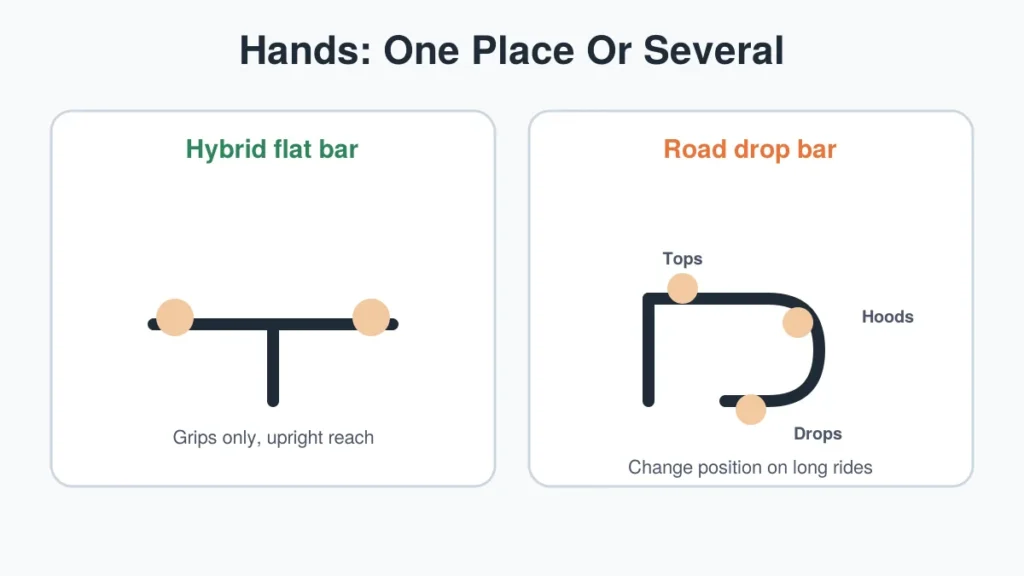
Hybrids feel comfortable straight away because of the upright position and thicker tires. Road bikes can be comfortable too, but they usually need some setup and adjustment first.
Drop bars give you tops, hoods, and drops, so you can change posture on a long ride. A flat bar gives you one position, which is simple, but you can’t move around as much.
When I first rode a road bike, I lived on the hoods for weeks and barely touched the drops. It took time to trust the posture.
I also check brake lever reach on every test ride. It’s a habit left over from the Phoenix days, when the levers needed more hand than I had.
Upkeep and Running Costs
Canyon’s view is that hybrids generally need less frequent maintenance, while road bikes need closer attention to tire pressure and a clean drivetrain. I’d put it more simply: narrow tires and light parts forgive less.
I’m not quoting prices, because they vary by country, shop, and season. Compare your local price bands.
If either bike gives you hand, neck, or knee pain, book a bike fit. See a health professional if the pain persists.
The In-Between Options Worth a Test Ride
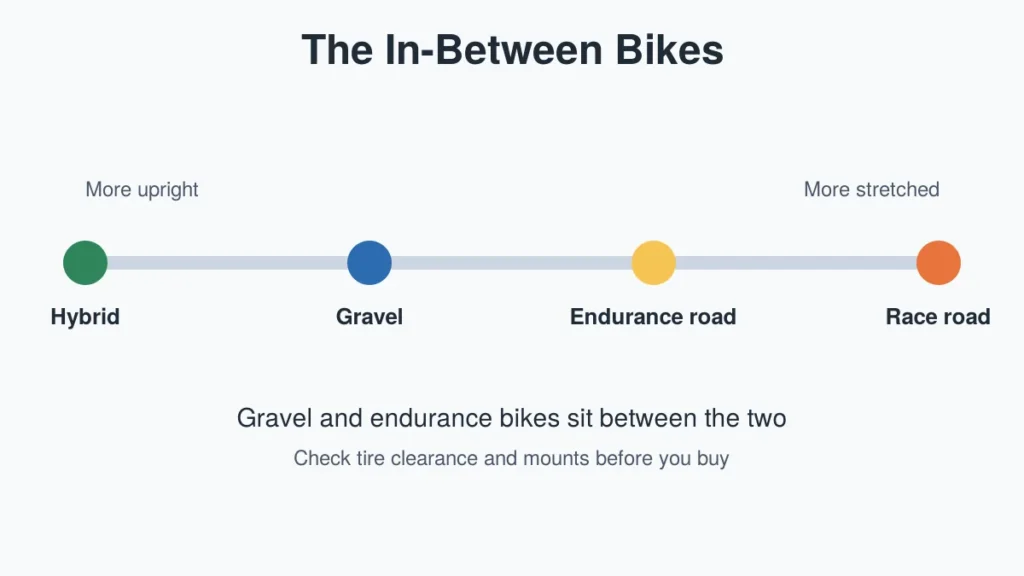
You don’t have to pick a side. Two bike types sit in the middle, and they solve the exact dilemma this guide is about.
- Endurance road bikes keep the road look with a more relaxed riding position, according to Canyon.
- Gravel bikes offer more tire choices, gearing suited to climbing, and mount points for racks and fenders.
Don’t assume a particular model has the clearance or mounts you want. Read the specs, and confirm with a shop.
A Simple Test Ride Plan Before You Buy
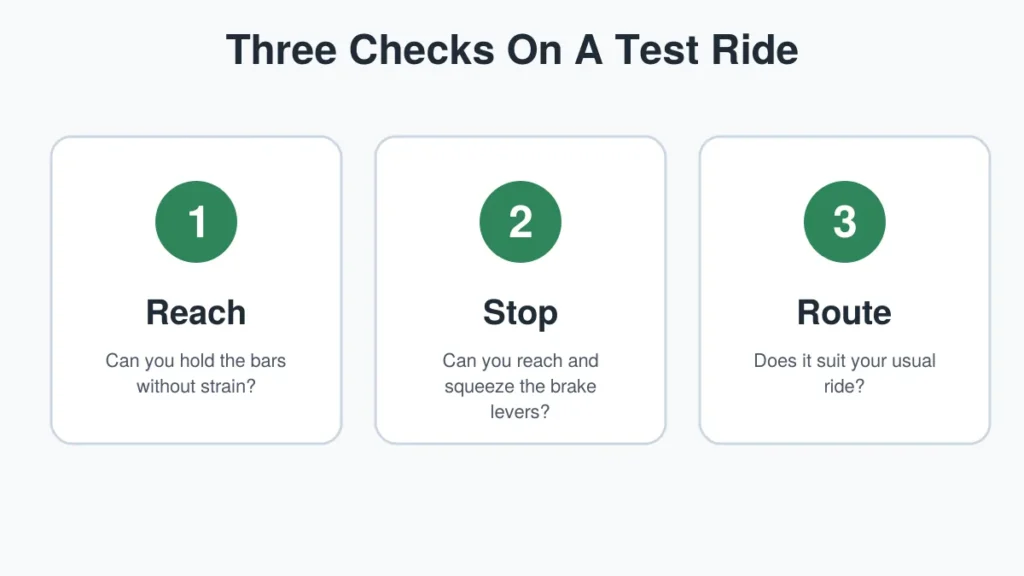
A spec sheet can’t tell you what a bike feels like. A 15 minute test ride can.
- Reach. Hold the bars in each hand position. Your shoulders should stay relaxed.
- Stop. Squeeze the brake levers from every hand position. You should reach them easily.
- Foot down. At a stop, check you can put a foot down comfortably.
- Route. Ride a surface like your usual one: rough patches, a hill, or a busy street.
My three question rule fits on a napkin.
- Do you need to carry things or ride in rain? Choose the hybrid.
- Will you ride with groups or steady paved miles? Choose the road bike.
- Neither? Pick the one that felt better on the test ride.
FAQs About Hybrid vs Road Bike Choices
Can I swap the handlebars on a hybrid to turn it into a road bike?
Rarely worth it. Drop bars need compatible brake levers and shifters, and the frame’s reach is designed for flat bars, so the fit can feel off. Ask a shop for a full quote, then compare it with the cost of a used road bike.
What tire pressure should I run on each bike?
Follow the range printed on the tire sidewall and the maker’s chart. As a rough reference, Roadman Cycling suggests 70 to 85 psi for a 28 mm road tire with a 70 to 80 kg (154 to 176 lb) rider. Wider hybrid tires run lower.
Do I need clip in pedals and cycling shoes for a road bike?
No. Flat pedals and ordinary shoes work fine on both bikes. Canyon notes clipless pedals can help if you’re chasing speed, but they take practice to unclip at stops. Start with flat pedals, and add clip ins later if you want them.
Is a used road bike or hybrid a smart first purchase?
Often, yes. Have a shop check the brakes, tires, chain, and frame for cracks before you ride it. Brake pad wear is the first thing I look at, and a shop can measure it against the pad’s wear limit, so you know what you’re buying.
Can I fit wider tires on a road bike?
Sometimes. Many frames take 28 mm, and some take more, but it depends on the frame and fork. Check the maker’s stated maximum. If a 25 mm tire leaves 3 to 4 mm of clearance, 28 mm will likely fit.
My Pick, and When I’d Change It
If you made me choose one bike for a first purchase, I’d say hybrid. It forgives mistakes, takes a rack and fenders, and lets you ride a mix of surfaces while you figure out what you like.
I’d change that answer fast if you already know you’ll ride with a group or chase steady paved miles. Then the road bike’s position earns its keep, and the 1 mph or so it gives you will matter every ride.
Wherever you land, buy the bike for the ride you actually do, and do the test ride before you decide.
Written by: Raaz | Writer at TheMileRider. Learned to ride late, has spent about two decades on road, mountain, and everything between, and now writes about everything from first rides to brake pad wear limits.
1 Comment