

 By
Most people choosing between these two bikes are really choosing between two versions of themselves. One rides to the shops and back. The other disappears down a dirt road for the day.
I’ve ridden both kinds of bike for about two decades, and I’ve watched friends buy each one for the wrong reasons. The gravel bike vs hybrid question gets easier once you see how much the two overlap, and where they stop.
I’ll show you the overlap, run some numbers I haven’t seen anyone else bother with, and tell you plainly how I’d decide if it were my money.
Quick Takeaways:
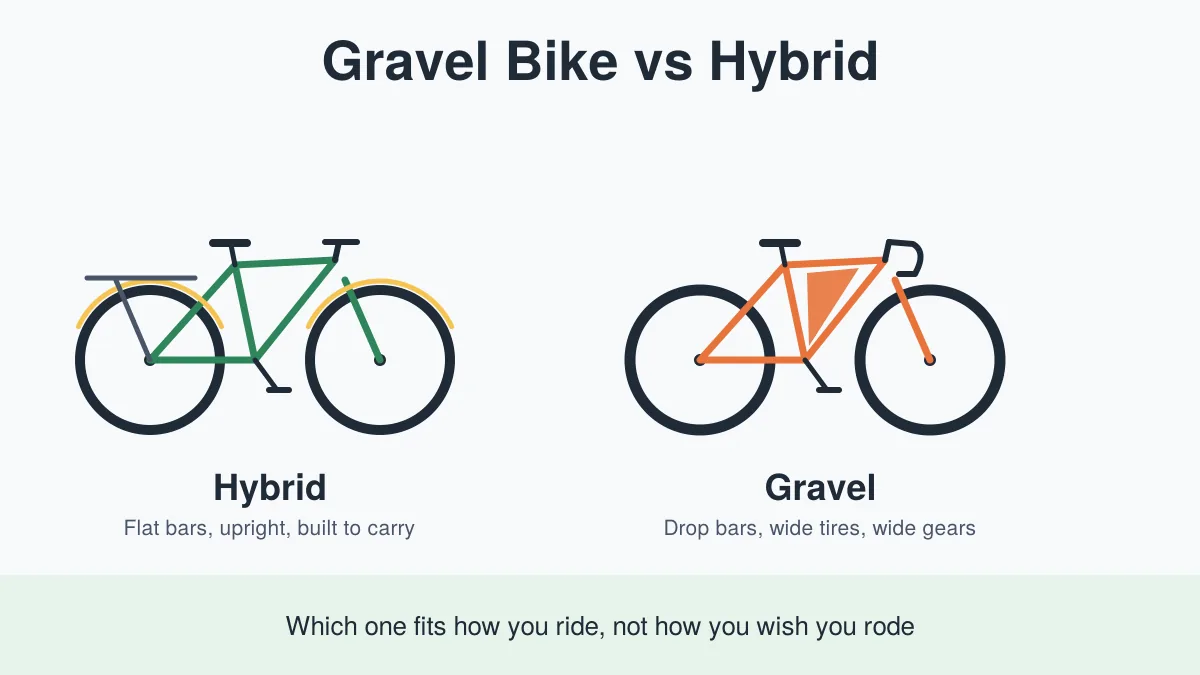
- Almost every hybrid has flat bars. Gravel bikes mostly have drop bars, though a few, usually budget models, use flat bars.
- The tire ranges overlap, so a 38 mm tire can sit on either bike. The tire isn’t the real difference.
- On the same effort, a gravel rider on the hoods is only about 0.4 mph (0.7 km/h) faster than a hybrid rider. In the drops, it’s about 1.2 mph (1.9 km/h).
- A modern 1x gravel setup covers about the same gear range as a typical 2x. The difference is step size, not range.
- Choose by your last five rides, not your next five.
The Short Answer: Match the Bike to Your Surface and Your Load
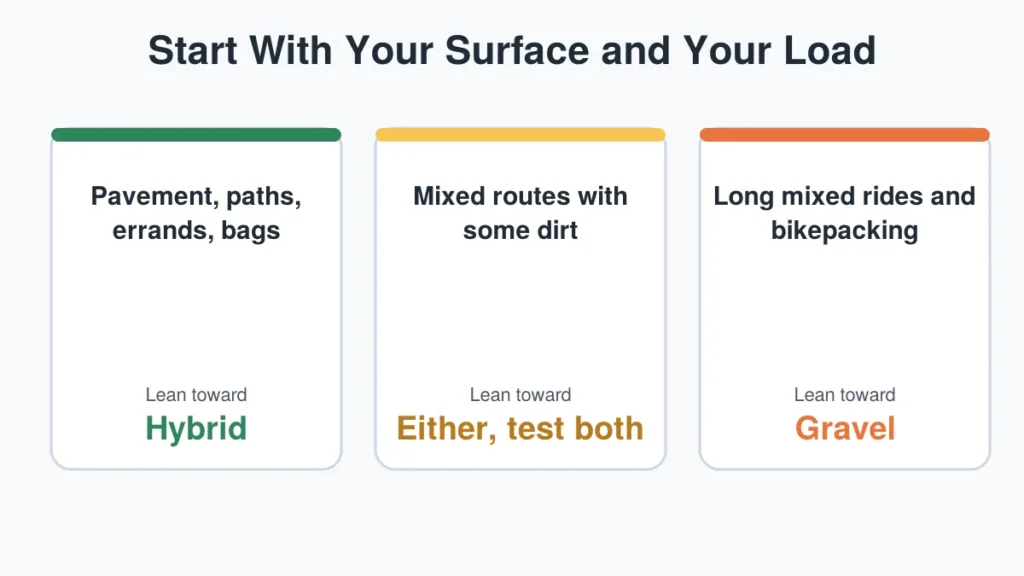
Most people buy for the ride they’d like to take, not the ride they actually take. So I use a simple test. Think about your last five rides, not your next five.
If those were pavement, paths, and errands, with a bag on your back or a pannier on the bike, a hybrid fits. If they were long, mixed surface rides, or you’re planning multi day trips, gravel fits.
| Your Usual Ride | Lean Toward | Why |
|---|---|---|
| Errands and commuting on pavement | Hybrid | Upright view, rack and fender mounts |
| Paved paths and light gravel | Hybrid | Stable and easy to control |
| Mixed surface weekend loops | Gravel | Tire clearance, gear range, more hand positions |
| Multi day trips with gear | Gravel | Mounting options and efficiency over distance |
| Commute with some rough bits | Either | Depends on the length and the load |
What Actually Separates a Gravel Bike From a Hybrid
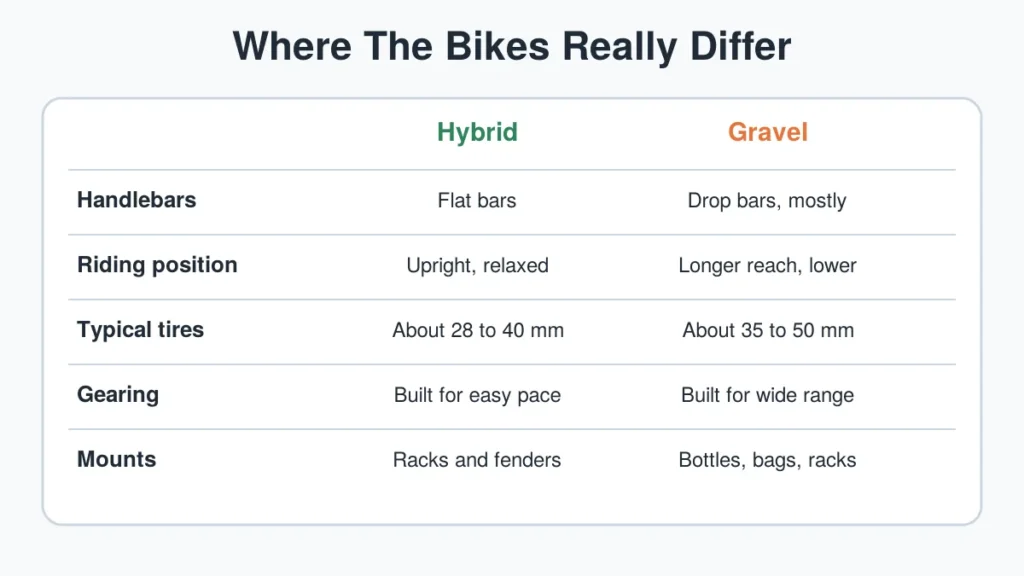
Five things set these bikes apart: the bars, how you sit, the tires, the gears, and what you can bolt on. Some matter more than the sales pages let on.
Handlebars and Riding Position
Flat bars give you leverage and calm at low speed. Drop bars give you options. That single trade-off explains most of the buying advice you’ll read.
I value options more on long rides, and calm more in traffic. If your rides are short and busy, the hybrid’s higher, shorter position wins. If they’re long, the drops pay you back, because you can change posture.
Tires and Clearance
Hybrid tires commonly run about 28 to 40 mm. Gravel tires commonly run about 35 to 50 mm. Published ranges vary a little, so check the exact model.
Here’s the part spec sheets don’t tell you. A listed maximum assumes a clean frame, and mud packs into that gap fast. I treat the stated clearance as a ceiling and leave myself some room under it.
Gearing and Climbing Range
Gravel gearing is meant to cover fast flat sections and steep climbs. Hybrid gearing tends to be aimed at slower speeds. Beyond that, the usual advice gets vague, so I worked it out.
Take Shimano’s GRX options. A 1x setup with a 40T chainring and a 10 to 51T cassette gives a low gear ratio of about 0.78 and a high of about 4.0. A 2x with 46/30T chainrings and an 11 to 36T cassette gives about 0.83 and 4.18.
Those are nearly the same. At 70 rpm on a 40 mm tire (I assumed a 2.15 m wheel circumference), the 1x low gear moves you at about 4.4 mph (7.1 km/h), and the 2x low gear about 4.7 mph (7.5 km/h).
So range isn’t what separates 1x from 2x anymore. Step size is. The 1x has bigger jumps between gears, and the 2x has finer ones.
Mounts and Carrying Capacity
Hybrids generally come with eyelets for a rack and mudguards. Many gravel frames offer mounts for bottles, bags, and racks.
I count mounts before I count anything else. You can change tires in an afternoon, but you can’t add eyelets to a frame that doesn’t have them.
The Overlap Zone: Where These Bikes Look Almost Identical
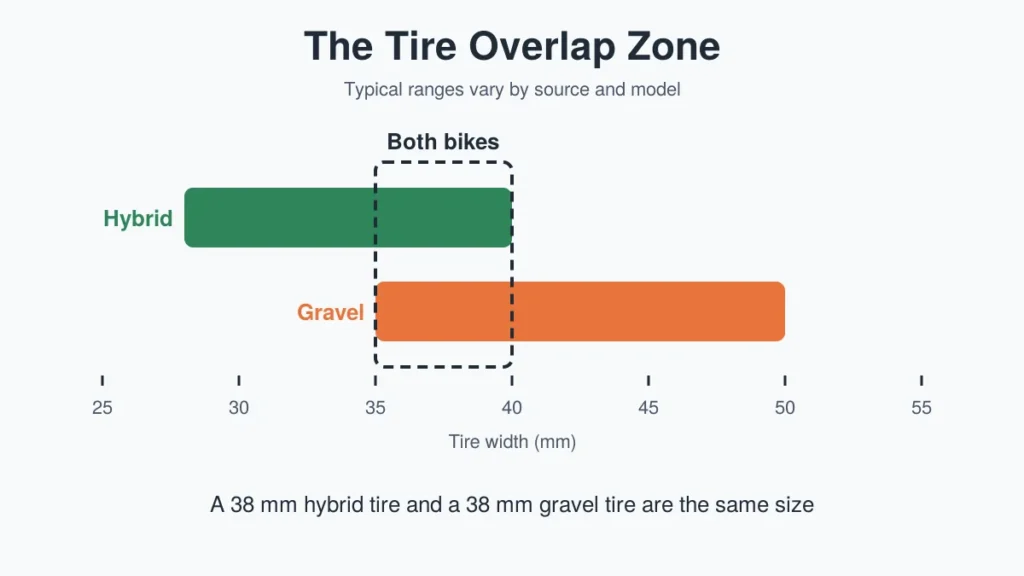
Between 35 and 40 mm, the same tire fits either bike. A 38 mm hybrid tire and a 38 mm gravel tire are the same size.
That overlap is why shop floor comparisons mislead. The tire isn’t the product. The bars, the geometry, the gearing, and the clearance are, and none of those can be swapped as casually as a set of tires on a Saturday afternoon.
What You Can Change Later
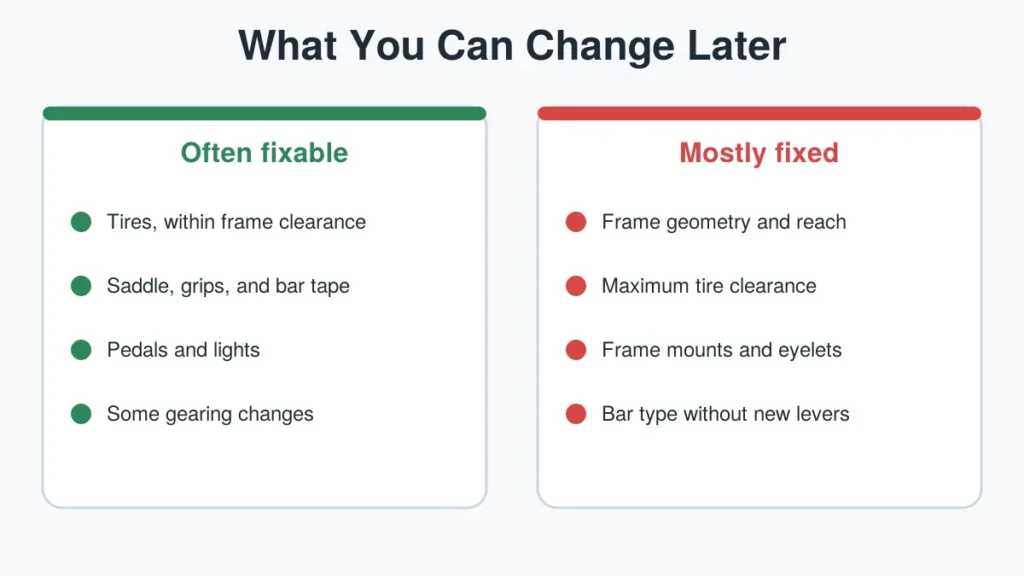
I sort the decision into what you can fix after you buy, and what you’re stuck with. It’s the most useful filter I know.
| Part | Change It Later? | Note |
|---|---|---|
| Tires | Often | Within the frame’s clearance |
| Saddle, grips, bar tape | Yes | Cheap and quick |
| Pedals and lights | Yes | Personal preference |
| Handlebars | Possible | Switching bar type usually means new levers and shifters |
| Frame geometry | No | It’s built into the frame |
| Maximum tire clearance | No | Set by the frame and fork |
| Mounts | Mostly no | Check before you buy |
Buy the Frame, Not the Tires
Tires are the cheapest thing on that list to swap. So I choose the bike whose frame matches the riding I want, then sort out the rubber afterward.
That’s why clearance and mounts matter more to me than the badge on the head tube.
How Much Faster Is a Gravel Bike?
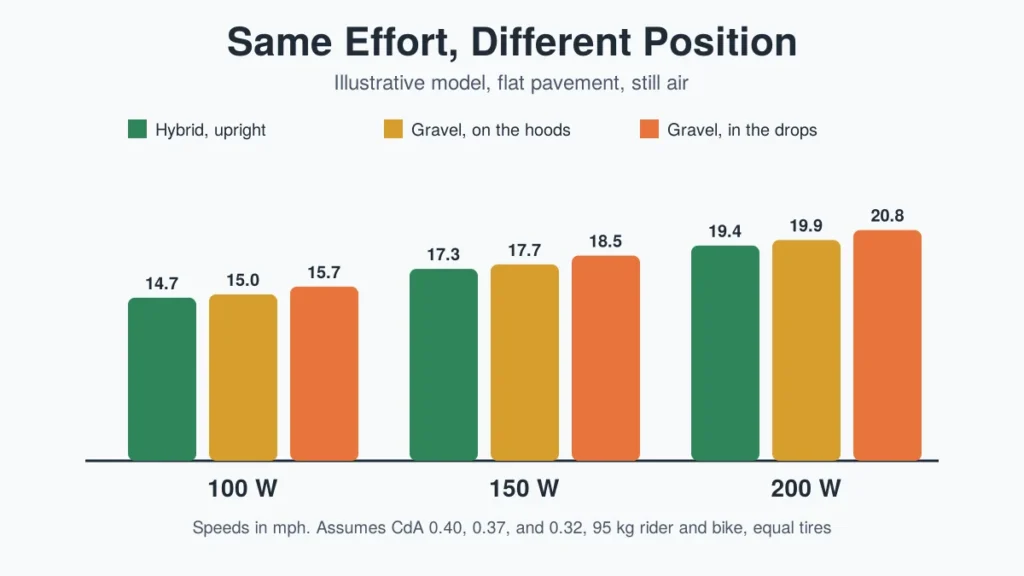
The common claim is that gravel bikes are faster. Often that’s true, but I wanted to know how much of it is just position, so I ran a simple model for flat pavement and still air.
What the Model Shows
I used published drag figures: a CdA (drag area) of about 0.40 for an upright hybrid rider, 0.37 for a gravel rider on the hoods, and 0.32 in the drops.
| Effort | Hybrid, Upright | Gravel, on the Hoods | Gravel, in the Drops |
|---|---|---|---|
| 100 W | 14.7 mph (23.6 km/h) | 15.0 mph (24.2 km/h) | 15.7 mph (25.2 km/h) |
| 150 W | 17.3 mph (27.9 km/h) | 17.7 mph (28.6 km/h) | 18.5 mph (29.8 km/h) |
| 200 W | 19.4 mph (31.2 km/h) | 19.9 mph (32.0 km/h) | 20.8 mph (33.4 km/h) |
Here’s how I read it. On the hoods, a gravel bike gives you about 0.4 mph at 150 W. The big gain only arrives when you actually get into the drops.
Most gravel riders I know sit on the hoods most of the time. So the honest speed advantage is the middle column, not the right one.
Assumptions Behind the Numbers
- Rider plus bike weigh 95 kg (about 209 lb).
- Rolling resistance is the same for both bikes.
- Sea level air, flat road, still air.
- Weight differences between the bikes are ignored.
I ran this myself, so treat it as an illustration, not a lab test.
What the Model Can’t Tell You
The model says nothing about surfaces. On loose, uneven ground, grip and control matter more than watts, and that’s where wider tires and a stable geometry earn their place.
So on pavement the gravel advantage is modest. Off it, the advantage is real.
Which Rider Are You?
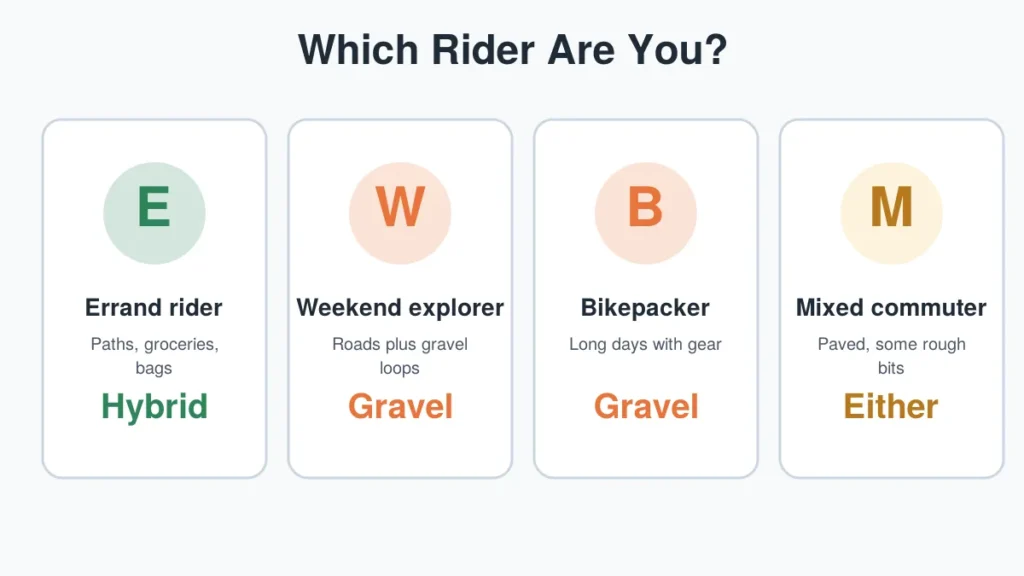
Here are four riders, all hypothetical, and where I’d point each one. My rule of thumb: if you can’t name a surface that needs tires wider than 40 mm, you probably don’t need a gravel bike.
The Errand Rider
Picture a 4 mile (6.4 km) loop to the shops, with a pannier and a stop at nearly every junction. Speeds stay low, the model gap is small, and you want a rack, mudguards, and an upright view.
That’s a hybrid. A gravel bike would work, but you’d be paying for abilities you’d rarely use.
The Weekend Explorer
Picture a 35 mile (56 km) loop where a third of it is gravel road. This is where drop bars, tire clearance, and a wide gear range start to earn their keep.
I’d choose gravel, and I’d run softer tire pressure on the dirt than I would on pavement.
The Bikepacker Carrying Gear for Days
Bikepacking is the clearest case for gravel, because you’re riding far with a load. A hybrid can carry gear, but it’s less efficient across long distances.
The deciding question is how many days you’ll ride with weight on the bike.
What to Check Before You Buy
- Bottle mounts, so you can carry water without a pack.
- Rack and fender eyelets, if you plan to carry more.
- Frame bag room, so a bag doesn’t rub your knees.
The Mixed Commuter
Picture a 9 mile (14.5 km) commute with a canal path stretch. If the route is mostly paved and urban, a hybrid is the practical choice. If it’s longer or rougher, gravel starts to make sense.
I’d call this one a coin flip, so test both on your own route.
Where I Disagree With the Usual Advice
You’ll often read that a hybrid is the beginner bike and gravel is for keen riders. I don’t buy that.
Gravel works fine for a beginner who wants drop bars and room to grow. The real barrier is the learning curve of the bars, not skill.
Comfort, Hands, and the Learning Curve
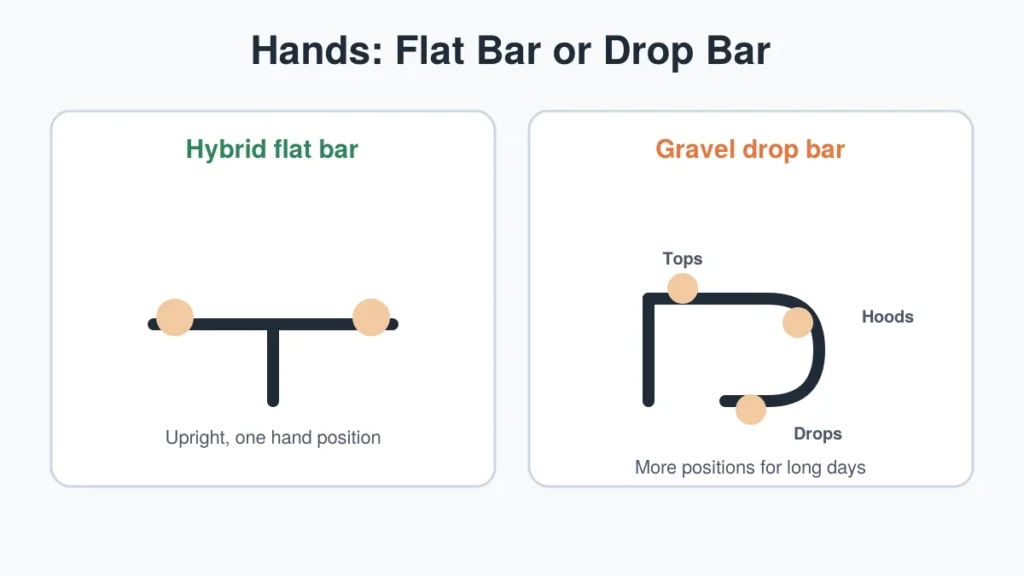
Flat bars give you one hand position and simple control at low speeds. Drop bars give you several, which helps on long days.
On a gravel bike, I’ve found the position that feels fastest on pavement isn’t the one I want on loose ground. There I stay on the hoods with my fingers near the levers.
Hybrids ask less of you at first. Gravel asks you to learn your bars, which takes a few rides, and then it pays you back on every long day after that.
If either bike gives you hand, neck, or knee pain, book a bike fit. See a health professional if the pain persists.
A Test Ride Plan Before You Buy
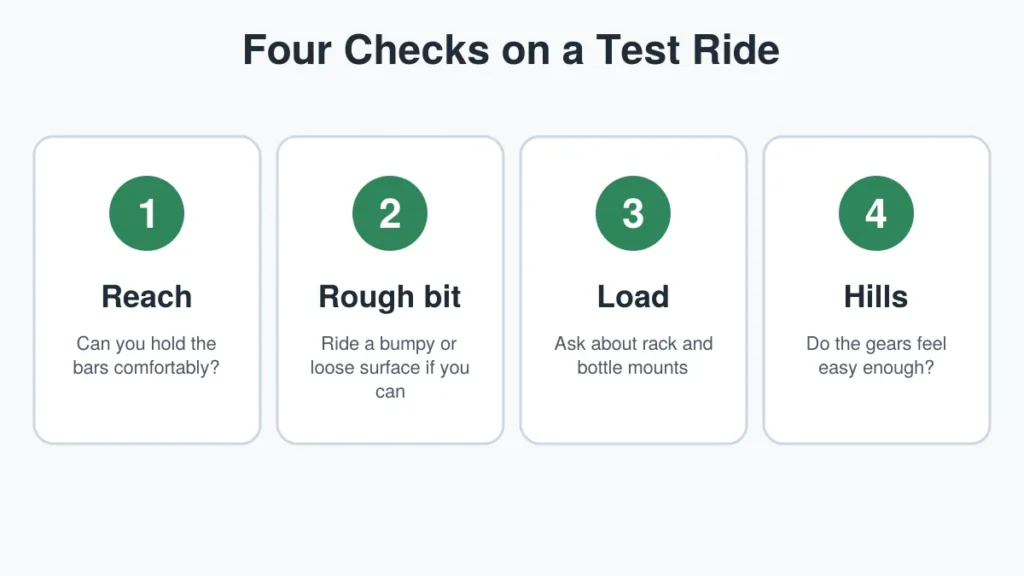
A spec sheet can’t tell you what a bike feels like. A 20 minute test ride can.
- Reach. Hold the bars in every hand position. Your shoulders should stay relaxed.
- A rough bit. Ride something bumpy or loose if the shop allows it.
- Load. Ask about racks, fenders, and bottle mounts for the way you’d use it.
- Hills. Check the lowest gear feels easy enough for your steepest climb.
My two question rule fits on a napkin.
- Does your usual ride include surfaces your tires would hate? If yes, lean gravel.
- Do you often carry more than a daypack? If yes, lean hybrid, unless the trip is long.
FAQs About Gravel Bike vs Hybrid Choices
Is a 1x drivetrain better than a 2x on a gravel bike?
Not better, just different. With a wide cassette, a 1x covers about the same gear range as a typical 2x. The difference is step size: 1x has bigger jumps, 2x has finer ones. 1x is also simpler, with fewer parts to maintain.
What are flared drop bars?
They’re drop bars that curve outward at the bottom, so your hands sit wider in the drops. The wider stance can give better leverage when riding out of the saddle. Try them on a test ride, since the feel varies from rider to rider.
Is a flat bar gravel bike a good compromise?
It can be. A few gravel bikes, typically budget ones, use flat bars, and conversions from drop bars are common. You keep the clearance and geometry with upright hands, but lose the extra hand positions. Ask a shop what parts a conversion would need.
How do I check tire clearance before buying?
Look up the maker’s maximum tire width, then check the gap around a fitted tire at the fork, chainstays, and seat stays. Roadman Cycling uses 3 to 4 mm of daylight as a guide when moving up one size. Mud needs extra room.
Can I do road group rides on a gravel bike?
Yes, with caveats. Even with slick tires, a gravel bike’s gearing may make reaching and keeping higher speeds harder. Ask the group about its usual pace first, then check the top gear on your bike against that speed before you turn up.
My Pick, and When I’d Change It
If most of your riding is pavement, paths, and errands, I’d buy the hybrid and not think twice. It’s built for that, and it asks nothing of you except that you ride it. Simple.
If you keep eyeing the dirt road beside the paved one, or you daydream about long days with a bag on the frame, buy the gravel bike. Check clearance, gears, and mounts first.
Either way, take a test ride on a surface like yours.
Related Articles
- How to Fix a Flat Tire on a Bike: Step-by-Step Guide
- Hybrid vs Road Bike: A Practical Guide for First-Time Buyers
- How To Start Cycling As A Complete Beginner: Simple Steps
- How to Tell When Your Bike Chain Is Worn Out: 4 Checks
Written by: Raaz | Writer at TheMileRider. Learned to ride late, has spent about two decades on road, mountain, and everything between, and now writes about everything from first rides to brake pad wear limits.